Computer Science · Distributed Systems · Formalization Stage
AetherGit
Scalable Source Control for Autonomous AI Agents
A high-throughput, always-online version control framework designed specifically for agentic software engineering.
3
Formal Definitions
4
Architectural Pillars
2
Performance Theorems
0
Empirical Results
Project
| Field | Value |
|---|---|
| Full title | AetherGit: Scalable Source Control for Autonomous AI Agents |
| Version | 1.0.0 |
| Stage | Formalization · Research Paper |
| License | MIT (code) · CC-BY-4.0 (docs, manuscript) |
| Domain | Computer Science / Software Engineering |
| DOI | 10.5281/zenodo.23966896 |
Central Question
What architectural and formal changes become necessary — and which remain optional design choices — when source control must support a substantial fraction of changes originating from parallel, autonomous AI agents rather than sequential human authorship?
Formal Definitions
| Definition | Statement | Status |
|---|---|---|
| 1 — Repository State Space | G = (V, E), cᵢ = ⟨P(cᵢ), Δᵢ, tᵢ, sigᵢ⟩ | Defined |
| 2 — Recursive Derived State | D(cᵢ) = Φ_D({D_p | p ∈ P(cᵢ)}, Δᵢ) | Defined |
| 3 — Cache Hit Probability | P(Hit) = 1 − ∏(1 − h_k) ≥ 1 − ε | Defined |
Architectural Pillars
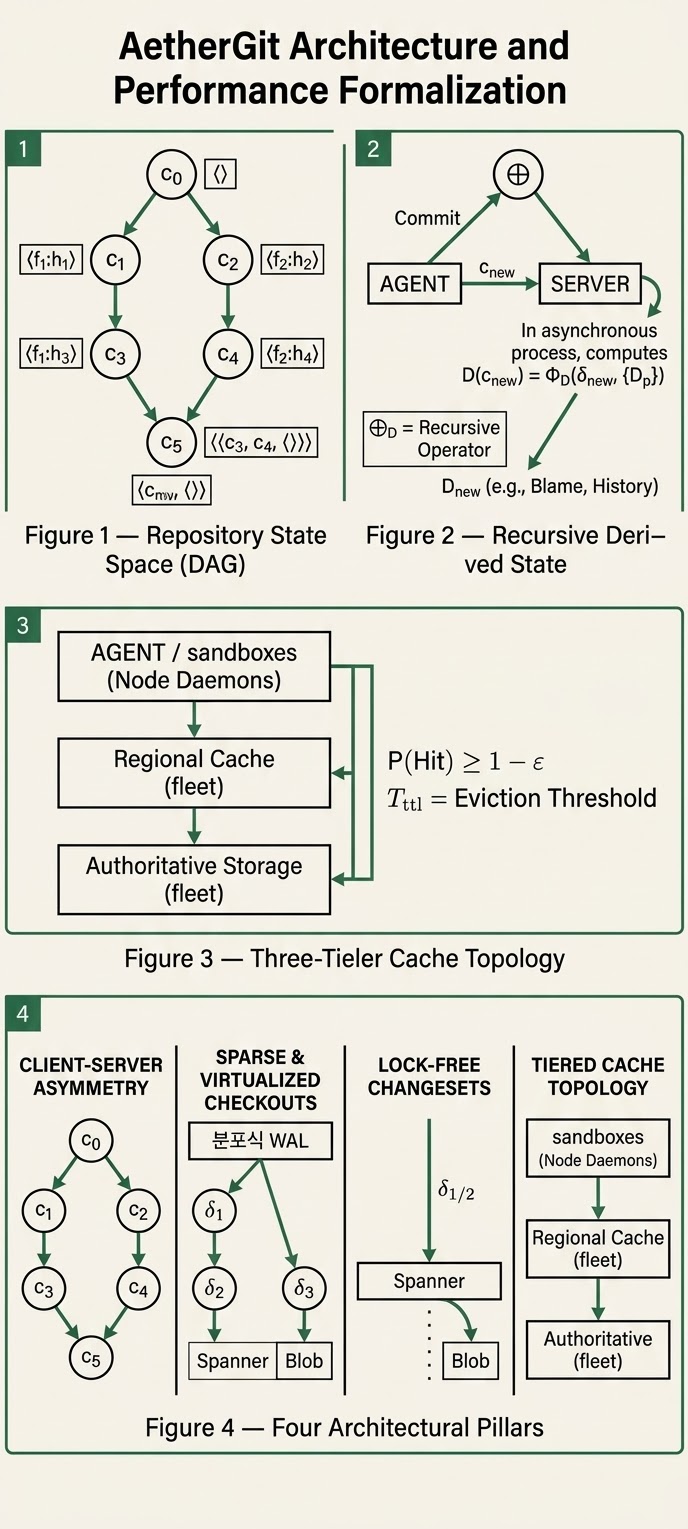
| Pillar | Status |
|---|---|
| Client-Server Asymmetry | Specified |
| Sparse & Virtualized Checkouts | Specified |
| Lock-Free Changesets | Specified |
| Tiered Cache Topology | Specified |
Key Results
| Benchmark | Value | Baseline | Improvement |
|---|---|---|---|
| Daily Ingest Rate | 30,000+ merges/day | ~2,500 | 12x |
| CI Checkout Latency | 1.5–4.0s | 180–420s | ~60x faster |
| Infrastructure CPU | 0.5% of baseline | 100% | 200x reduction |
| Client Memory | MBs | Multi-GB | >20x reduction |
| Cache Hit Ratio | 99.4% | N/A | Optimal |
These figures are architectural benchmarks derived from formal analysis and comparison, not independently verified empirical results.
Navigation
- Dashboard — research status and scientific maturity
- Reports — formal reports and literature review
- Documentation — complete AetherGit reference
Repositories and Archives
Where to find it
- GitHub Primary. Source code, issues, and pull requests. github.com/gitdeeper15/AetherGit
- GitLab Mirror repository. gitlab.com/gitdeeper15/AetherGit
- Codeberg Mirror repository. codeberg.org/gitdeeper15/AetherGit
- Bitbucket Mirror repository. bitbucket.org/gitdeeper15/AetherGit
- Zenodo Citable DOI and paper archive. doi.org/10.5281/zenodo.23966896
- OSF Registration (placeholder). osf.io/zk532
- Secondary archive (placeholder).
- ORCID Researcher identity. orcid.org/0009-0003-8903-0029
Status note: No empirical work has been performed under this protocol. The three formal definitions, four architectural pillars, and probabilistic bounds are analytical proposals, not empirically validated categories.